Showing posts with label Photo Sculpture. Show all posts

Sunday, 10 July 2011

Rebel Relief

Sam Burford, Star Wars Relief, 2011

Sam Burford's Star Wars Relief is a timelapse photograph taken from the film Star Wars IV. Burford uses a bespoke capture device to record the film footage that is then rendered as a series of extended (and abstract) film stills (see example here). In this instance the image has been transformed into a surface relief made from silicon - a material previously used in film production to create sets and props. The relief work subsequently has allusions to pre-digital cinematic model making methods and aesthetic reference to the surface structure of the Empires Imperial Starships and Space Station.

Friday, 4 February 2011

Folding Space


Riyo Nemeth, Fold II, 2010
Rendered in physical space, Riyo Nemeth composes and records the Photoshop gradient affect by printing and folding a sheet of paper.

Saturday, 24 July 2010

The camera is the all seeing eye of God

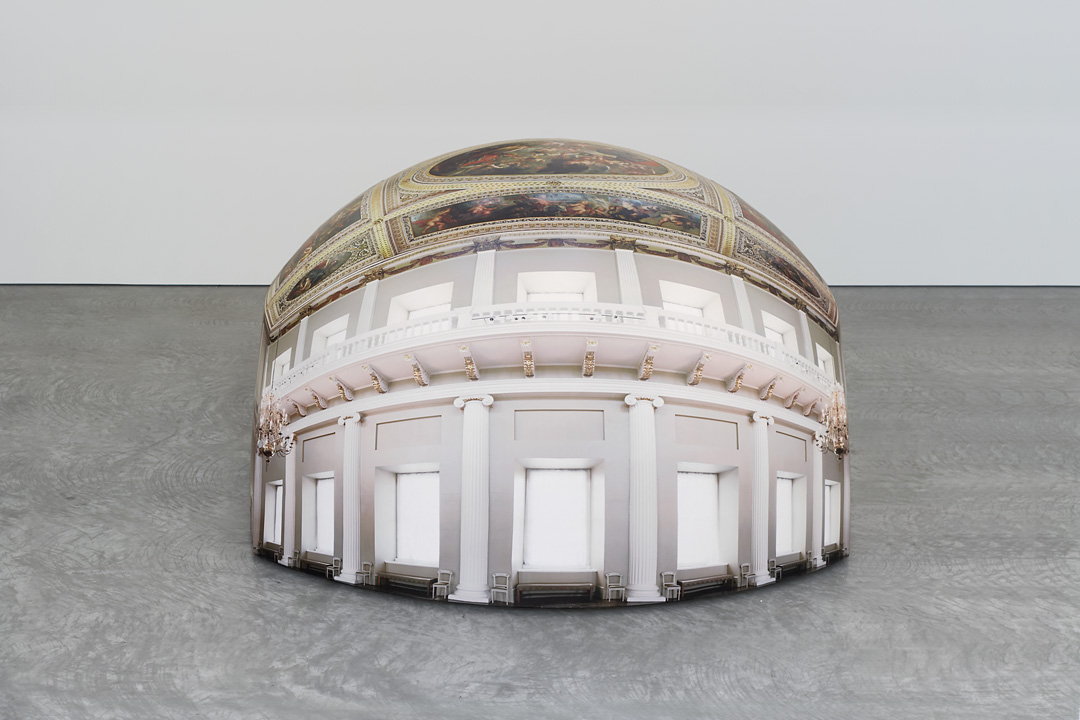
Brandon Lattu, Banqueting House, 2007
Lattu created the Banqueting House by photographing the interior of the Titular building in London and wrapping the photographic image on the exterior of a foam, polyster resin shape. The sculpture's form was created as a hybrid shape between the monocular perspective of a camera and the interior space of the Titular buildings Vitruvian proportions.

Saturday, 1 May 2010

Edges of a hardcore

Pixxxel, Jean-Yves Leoigne for AMUSEMENT
The collaging of pixel resolutions within a ppi (pixels per inch) determined virtual image space forces one to get physical with the virtual.

Thursday, 29 April 2010

"I see you"


Dutch: What's got Billy so spooked?
Sergeant Mac Eliot: Can't say, Major. Been actin' squirrelly all morning. That damned nose of his.... its weird.
Dutch: What is it? Billy? What the hell is wrong with you?
Billy: There's something in those trees.
Dutch: Do you see anything?
Billy: Up there ahead.
Dutch: Nothing. What do you think?
Billy: I guess it's nothing, Major

Saturday, 17 April 2010

It's the thought that counts......

Fake flowers in full colour, Hans Gremmen and Jaap Schereen, 2008-09
Interflora adjusted logo
Art is a gift - B. Reid
Making artwork that is informed by a technical process often seems far more relevant than the technical mastery of that process.

Friday, 9 April 2010

Built to be seen

The Cartel, Ray Kinsella 2009, 3D Plaster Print - produced on a Z Corp Z printer

The model is an in between form, it shifts between disciplines
Ian Kiaer, 2009

Source: Ray Kinsella (Kevin Costner) in the 1989 movie Field of Dreams.

Ray Kinsella is part of Build it and they will come a collaborative project between Paul Laidler and Brendan Reid that refers to architectural practice within a fine art context. The work contains a series of four quotes that have architectural connotations and are printed using rapid prototyping technology to create 3D text-based objects. The 3D printing process is used as device to create a series of self-referential dialogues within the work.


The work:

Kinsella (a crop farmer) is walking through his crop field one evening where he here’s a voice uttering the words ‘If you build it, he will come’. After pondering the meaning of the words Kinsella decides to construct a baseball pitch in his cornfield, despite the financial risks to his farm and family. Not completely assured as to why he is making the pitch the compulsion to do so out ways any thoughts of purpose or economic return for the pitch.

The compulsion to make has many parallels with art and its intended function (to be received by an audience). Toward the end of the film the baseball pitch becomes an attraction as it is deemed that ‘people will come’. Ray Kinsella was the first text piece that started this project and similar to the situation of the charactor Ray Kinsella the work had no intended audience, it was just a feeling that something had to be realised. In this instance the realisation was due to the fact that for the idea to function as an artwork it had to be more than an idea. As an idea the words ‘built and they will come’ remained a solitary and silent voice. For the idea to be ‘heard’ the text requires audience participation, therefore the work refers to itself as an object for exhibition - to physically exist in a space where ‘people will come’.

Also see the work in the exhibition 3D 2D: Object and illusion in Print at Edinburgh Printmakers